Guides
Does Location Sharing Work Without Internet?
Your phone can still find its location without internet, but nobody sees it until you're back online. Here's what works offline and what doesn't.
By NextLocator Team Updated 3 minute read
Quick answer
Partly. Your phone can still work out where it is without internet, because GPS comes from satellites. But it can't send that location to anyone until it's back online. A good family locator app saves the points on the phone while you're offline and sends them all once the connection returns, so the route fills in.
Key takeaways
- GPS doesn't need internet. Sharing your location does.
- While you are offline, your family sees your last known location and the time it was sent.
- NextLocator keeps recording offline and sends the saved points when you reconnect.
- Alerts and SOS need a connection to reach anyone.
Does GPS need internet?
No. GPS is a one-way signal from satellites. Your phone listens, works out its position, and that's it. It's the same reason a car sat-nav works in the middle of nowhere.
What internet adds is speed. Without data or Wi-Fi, the phone has to find the satellites on its own, which can take a minute, especially right after it's switched on. With a connection it gets a head start and usually finds you in a few seconds.
What does your family see when you go offline?
They see the last location your phone managed to send, with the time it was sent. In NextLocator the member card says something like Last seen 25 mins ago, so nobody mistakes an old location for a live one.
The usual places people drop offline:
- Lifts, basements and underground car parks
- Metro and long tunnels
- Bus or train journeys between towns
- Villages and highways with weak coverage
- A phone with mobile data switched off, or no data balance left
Most of these gaps are short. A lift ride is a few seconds. A highway stretch with no coverage can be half an hour.
How offline sync fills the gap
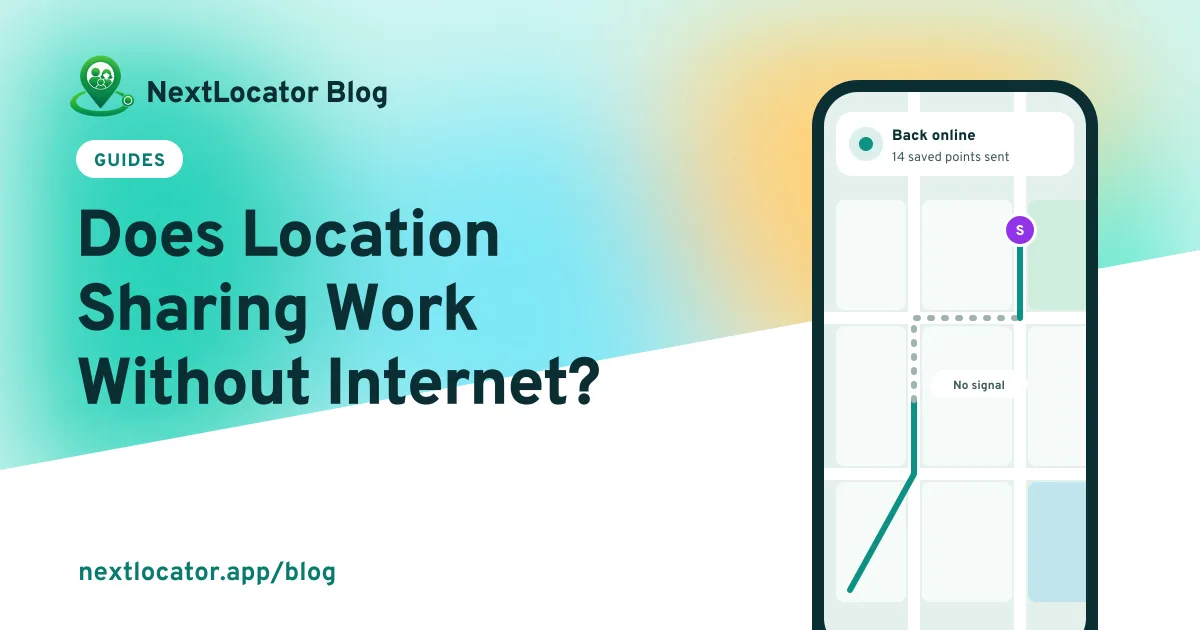
NextLocator keeps recording while you're offline. Each point is saved on the phone with its time. When the phone reconnects, it sends the saved points in one go, in order. Your family's map then shows the real route, not a straight line from where you lost signal to where you got it back.
Why this matters
Without offline sync, a 40-minute bus ride through a weak area shows up as one big jump. With it, you can see the road the bus actually took and where it stopped.
What still needs a connection?
| Feature | Works offline? | What happens |
|---|---|---|
| Finding your location | Yes | GPS works from satellites |
| Recording your route | Yes | Points wait on the phone |
| Family seeing you live | No | They see your last known location |
| Arrival and leave alerts | No | Need a connection to be sent |
| SOS alert | No | Needs a connection to be sent |
If you're somewhere with no data in an emergency, don't wait for the app. Call your local emergency number. Calls often get through where data doesn't.
How to keep the gaps short
- Keep mobile data on for the app, even if you limit other apps.
- If you use Data Saver, add NextLocator to the exceptions.
- Top up before a long trip. A phone with no data balance is offline even with full signal bars.
- Let the app run in the background. Battery settings stop updates just as surely as a dead zone does. See why a location stops updating.
- Check the Last seen time before you worry. An old time usually means weak signal, not trouble.
Frequently asked questions
Does Google Maps location sharing work without internet?
It can't send your location without internet. The people you share with see your last updated location until your phone connects again.
Can someone track my phone if mobile data is off?
Not through a location sharing app. The app needs data or Wi-Fi to send your location. Your mobile operator can still see which tower your phone uses, but that isn't shared with apps or family.
Does GPS use mobile data?
No. GPS itself is free and uses no data. Sending your location afterwards uses a very small amount of data.
How much data does NextLocator use?
Very little. Each location update is a small message, much smaller than a photo or a web page.